We asked Ramūnas Stankevičius, Machine Learning Engineer at Adroiti Technologies, how AI is changing engineering roles, what skills will matter most in the coming years, and why organisations themselves must rethink how they measure performance.
How Software Engineering Roles Are Changing in an AI-First Organisation?
As a data scientist, my day-to-day work has moved away from hands-on implementation and looks much more like orchestration. It is a great time to be in this field because we get a front-row seat in the AI theatre. We might not be building the frontier models, but knowing the math, statistics, and machine learning basics lets us look under the hood instead of just consuming the final output.
Specifically, the work has changed in a few key ways:
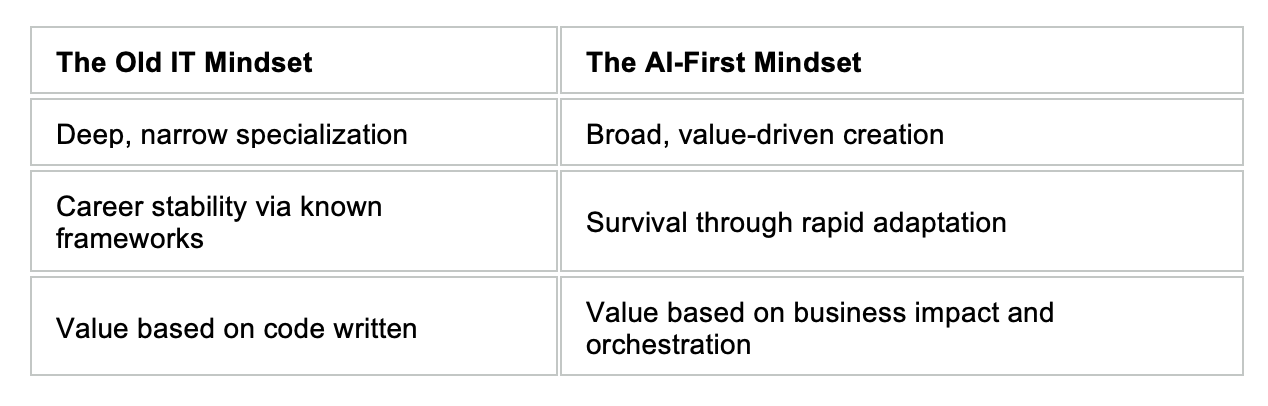
- Implementing vs. Orchestrating: Before 2026, I used AI mostly to process data or assist with code. Today, it delivers complete solutions. I spend the bulk of my time defining requirements, delegating to AI, and reviewing results instead of writing boilerplate code.
- The Adoption Split: My colleagues handle this differently. Some are leaning in hard, using AI to expand what they can do, like tackling DevOps, testing, or full-stack prototyping. Others are more conservative. They treat AI as a basic assistant or even see it as an extra hurdle.
Even with these changes, the core job is identical. You still need to understand the business and the data, know the architecture, communicate with your team, ensure you are actually creating value, and manage expectations.
What competencies will become the most important in the coming years?
The comfort zone of a predictable IT career path is totally gone. We all need to get used to a mild sense of anxiety and accept that constant adaptation is just part of the job now. Instead of trying to outrun the AI bus, we need to jump into the driver's seat.
To stay relevant, specialists need to focus on a few areas:
- Going Broad Instead of Deep: Since AI can handle the deep implementation work, we have to look wider. For example, if you used to avoid front-end work, you can now use AI to prototype full solutions on your own. It is about using that freed-up time to make a bigger impact.
- Delegating and Reviewing: Knowing how to formulate clear requirements and critically review what AI spits out is already becoming more valuable than writing the code manually.
- Focusing on Real Value: If you hand your routine tasks over to AI, you have the bandwidth to solve bigger problems for your clients and your team.
The transition from traditional software engineering to AI-first software development can be summarised in three fundamental shifts:
Will AI Replace Software Developers?
If you define a programmer as someone who just memorises syntax and turns perfect requirements into code, then yes, the market will need far fewer of them. That narrow role is essentially gone.
But the actual skills that make a great developer are still in huge demand.
- Fewer Coders, More Builders: Writing code purely as translation will likely become a hobby. The real engineering work survives. That means critical thinking, structuring logic, understanding complex systems, and weighing effort against value.
- The End of Silos: I actually feel a bit "angry-happy" about this. For years, high demand let some mediocre developers build walls around themselves. They could demand perfect requirements and take zero responsibility for the final product's quality or business value. AI is tearing that wall down.
- Owning the Outcome: The people who thrive will be the ones who actually care about the final result. If AI can write better code, we should let it. Our job is shifting to figuring out where value is needed and designing the right solutions to get there.
How should organizational culture change so that AI is not an isolated tool but a natural part of work?
For years, IT departments operated like a winter garden. Companies built artificial, protective bubbles to shield high-demand talent from uncertainty. That protective culture held people back earlier, and now it is no longer sustainable. Companies that keep paying specialists to do work AI can handle simply will not survive.
To make AI a natural part of everyday work, organisations have to change their culture:
- Dismantle the Bubble: Companies need to drop the rigid obsession with structure and process. They should build a culture that expects people to step outside their traditional job descriptions.
- Focus on Outcomes, Not AI Usage: Performance shouldn't be measured by vanity metrics like how many AI prompts an employee writes. Measure the actual business value they create, regardless of whether AI was the right tool for that specific task.
- Support Real Experimentation: Management has to provide the right tools and encourage safe experimentation. This will cost money, but it will pay off for companies that figure out how to do it right and uncover new opportunities.
- Redefine Career Paths: Leaders need to help their teams visualise their new career trajectories. When AI frees up an employee's time, the company needs to guide them toward new ways to create value instead of leaving them worried about their job security.
Organisations that successfully adopt AI will be the ones that redesign roles, encourage experimentation, and measure business impact instead of activity. For software engineering teams, AI is becoming less about automation and more about amplifying human judgment.
Key Takeaways
Will AI replace software developers?
Not entirely. AI is automating repetitive implementation tasks, but software engineers remain responsible for architecture, business understanding, critical thinking, and delivering business value.
What skills will software engineers need in the AI era?
According to Ramūnas Stankevičius, the most important skills will be AI orchestration, business understanding, adaptability, critical thinking, and the ability to review AI-generated work.
What is an AI-first organisation?
An AI-first organisation integrates AI into everyday workflows, empowers employees to experiment, and measures success by business outcomes rather than tool usage.
Follow our latest insights on Adroiti Linkedin!
Adroiti is a Lithuanian technology company building AI-powered systems and running senior engineering teams that deliver real, production-ready results.